Showing posts with label online database. Show all posts

Friday, October 11, 2013

Focus Friday: Gale Virtual Reference Library

The Gale Virtual Reference Library is one of the most convenient and comprehensive databases that Richland Library offers, and DCCCD students can access it from anywhere there is an Internet connection.

Image of a person reading a reference book The GVRL contains hundreds of full-text eBooks covering art, biography, business, education, environment, history, law, literature, medicine, multicultural studies, nation and world topics, religion, science, social science and technology.

My love for this database comes from its simplicity in browsing and retrieval. Use the search box located at the top of the home page or browse a particular eBook by clicking on the book itself, which will then display the table of contents.

The GVRL has many features, and allows students to save articles as they browse. By simply clicking the “Save Article” button located below each search result citation, the article is added to the “Saved Articles” list. Users can add up to 50 articles, which is great for writing in-depth research papers. From there, users can email saved articles to themselves or other users.

Create a Gale Bookmark in order to access saved articles after you have logged out.

Other features include the “Translate Article,” “Listen,” and “Download MP3” buttons. The “Translate Article” button includes a drop down list of 12 languages including Arabic, Chinese (simplified), Chinese (traditional), and French. Once the language is selected, a new window pops up with the translated article.

The “Listen” tool is also very impressive as the accent of the program reading the words sounds like a native speaker is reading. Users can even download articles and listen a later time. This is quite an amazing tool, and I think it is very good for people who are trying to improve in any language.

One of the most useful features I found was the citation tool, which will generate a citation of the article for you. Use this tool with discretion as some of the citations may have errors.

Working with this database is a great experience when used to its full potential. Check it out and see what you think.

Access it by going to the Richland College Library webpage, clicking on the green "Databases" tab, clicking on the “G” on the A-Z list, and clicking on the link to Gale Virtual Reference Library. (A log on is required outside of the library.)

C. Haynes

Friday, September 13, 2013

Focus Friday: CQ Researcher

Looking for a basic overview of a tough topic? Working on a current issues assignment and need a thorough topic overview? Trying to get started by searching the open Internet but finding too much or not enough information?

CQ Researcher is the focused resource for you, and you can easily access it through the Richland College Library database pages.

This 90-year-old publication covers one topic per publication and is written by veteran journalists. Each in-depth report includes a topic's overview, background, timeline, and a bibliography. There is also a pro and con feature in each report.

CQ Researcher is published 44 times a year on Fridays. Access it by going to the Richland College Library webpage, clicking on the green "Databases" tab, and clicking on the CQ Researcher link. (A log on is required outside of the library.)

Today's report is "U.S. Trade Policy," and next week's will be "Future of the Arctic." 

Below is a video about the features of the online CQ Researcher and how to use it.


If you have questions about how to use this or any other database, please ask a librarian. You may telephone 972-238-6082 or email richlandlibrary@dcccd.edu. 

Happy researching, 
R.D. 


Monday, March 25, 2013

Coffee through the ages

You almost certainly know people who drink coffee every day. You might even be one of those people.

Has coffee always been a staple in American households?

Daily Life through History is an academic source that displays a cross-section of everyday life over time and around the globe. This database, provided by ABC-CLIO, offers images, recipes, stories, and discussions that help students go beyond mere facts and statistics.

Use the Advanced Search feature to search for articles about coffee. Choose from a menu of categories, eras, regions, and subjects.

Here are some examples from a recent search for information about coffee in Europe and North America.
  • 17th Century Western Europe: Coffeehouses “emerged in the major cities of Western Europe after 1650 as venues for the consumption of the newly introduced beverages coffee, tea, and chocolate.”
  • 17th Century America: Before Pennsylvania built a public building for its legislature, the governing Assembly met in private homes, inns, or coffeehouses.
  • 19th Century: Cowboys and Civil War soldiers drank coffee every day.
  • 20th Century: During the Great Depression, real coffee was scarce. Some American families brewed a mixture of wheat bran, cornmeal, eggs, and molasses as a substitute for coffee.
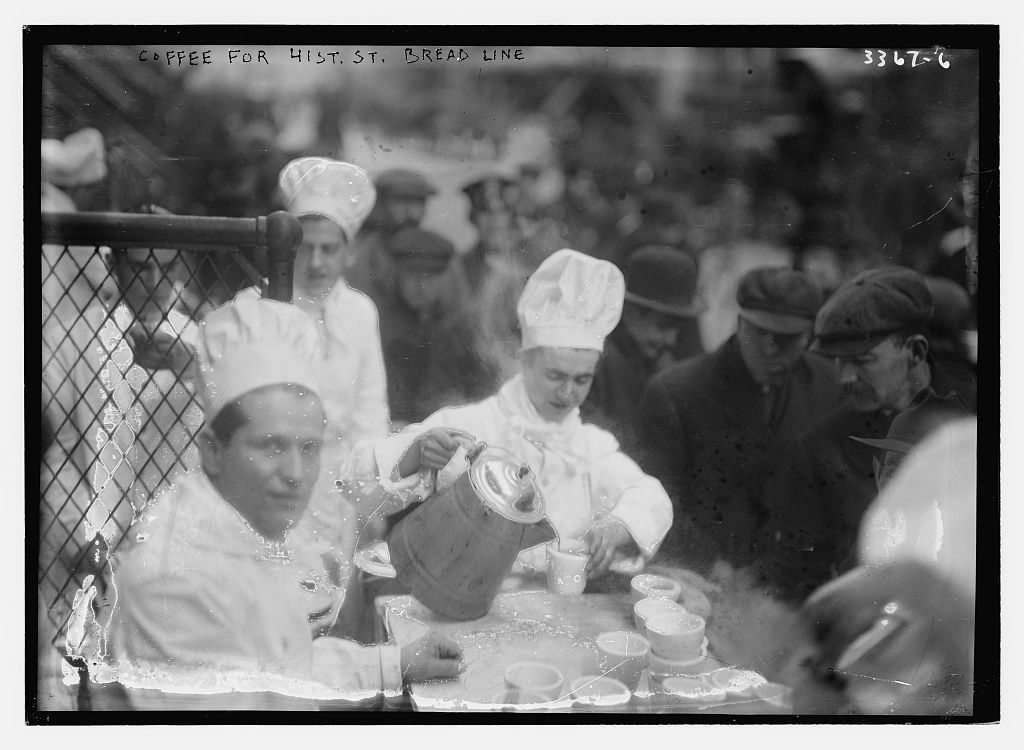
Coffee being served to a "soup" line. From the Library of Congress.
 Pre-WWI bread line. Library of CongressLOC collection via Flickr.
To get to Daily Life through History, follow this path:

1. Go to the Richland library webpage at http://www.richlandcollege.edu/library.
2. Look for the green tabs in the middle of the home page and click on “Databases."
3. Click on the “D” on the A-Z list.
4. Scroll down and click on the "Daily Life through History” link.

Pros:
  • Articles are typically short and easy to read.
  • The authors provide suggestions for further reading.
  • The citation in MLA format is posted at the end of each article.
Con:
  • This database is not useful for students who need current information. The most recent pieces on President Barack Obama, for example, are from 2011.
Here is a link to the search results for "coffee."  Students, instructors, and staff with current DCCCD I.D. can log on with their I.D. information.

~From Richland Librarian Terri C. 

Tuesday, February 19, 2013

Question of the week: Who’s Aurora Leigh and where is she?


Picture of Elizabeth Barrett Browning poetry books
Richland holdings of Aurora Leigh
How many times have you found yourself digging around looking for a copy of  Aurora Leigh by Elizabeth Barrett Browning, but you just couldn’t seem to find one? 

You’ve looked in the library catalog, but the Richland Library copies are checked out. Other district libraries have copies, but you don't have time to pick one up or to wait for a copy to come to Richland.

You could surf over to Amazon.com and purchase it for your Kindle, or you could search another library for a copy. You could go online to the Gutenberg Project to see if there is a copy there. You can Google it and find the University of Pennsylvania's digital library holding.

But...You will also need some literary criticism and maybe some biographical information about Elizabeth Barrett Browning, so just finding the digital version may not be enough. What if you easily could find a website that compiles multiple facets of literature and literary research?

Literature Online is one database that fits the bill. It is a web resource that contains full-text prose, full-text poetry, literary biographies, and literary criticism.

To get to Literature Online, follow this path: 

1. Go to the Richland library webpage at http://www.richlandcollege.edu/library.
2. Look for the green tabs in the middle of the home page and click on “Databases.
3. Click on the “L” on the A-Z list.
4. Scroll down and click on the “Literature Online” link.
5. Use the “Quick Search” box at the top left to find your work or author.

If you search Aurora Leigh, the database will give you results under the “Poetry,” “Criticism,” and “Reference” headings. For the poem, choose the first result under “Poetry.”

When you click on it, the title information looks like this:

Browning, Elizabeth Barrett, 1806-1861:  [from Poetical works (1897)]
Volume section

Browning, Elizabeth Barrett, 1806-1861 :

AURORA LEIGH.

A POEM IN NINE BOOKS. 1856. [from Poetical works (1897)]


Here, you can scroll through and start reading, click on the “Table of Contents” link to find the section you want, or you can print the 256 pages that comprise this selection. You may also click on the author page to find biographical information, bibliographies, and literary criticism.

Now, not only have you found Aurora Leigh, but you have also found a place where you can read all about her and her creator, Elizabeth Barrett Browning. 
 
Keep searching,
R.D. 


Here’s the durable link to  Aurora Leigh in Literature Online. Students, instructors, and staff with current DCCCD I.D. can log on with their I.D. information.

This is the first of several entries about finding literary works and related information and criticism.

Thursday, August 30, 2012

Get on board the LearningExpress

photo from http://office.microsoft.com/images
The DCCCD libraries have a subscription to the LearningExpress Library, which is a test prep/skills prep database. The practice tests and various exercises cover most of the disciplines taught here at Richland.

Students will find material to help them study for entrance exams including the THEA, SAT, and ACT. There is material for students in our pharmacy programs, and soon there will be more content for nursing students. There is content for grammar, composition, mathematics, and speech practice. There is professional certification practice for public servants and law enforcement.

Faculty, staff, and administrators should also find this database useful. It includes GRE study materials and practice tests; and it includes software training for various platforms and programs.

Visit the database by going to http://www.dcccd.edu/databases, clicking on "L," and scrolling down to the LearningExpress link. Just like all the library databases, this one is almost always available around the clock no matter where you're working. If you are accessing the databases from afar, use your name and student/employee I.D. number (no "e") to log on and start working. 

LearningExpress does require you to set up a profile within the database, so your work can be saved and accessed later.

Need a demo? Let us know by emailing richlandlibrary AT dcccd.edu.

Happy studying,
R.D.

Tuesday, February 16, 2010

Read freely : Online literature

“The pages of a book shield us from the distractions that bombard us during most of our waking hours.”

This quote from author
Nicholas Carr in
The New York Times blog post “Do School Libraries Need Books?” eloquently pinpoints my feelings about reading from the page rather than the screen.
 
Carr
(author of The Big Switch) and others thoughtfully discuss the print versus digital argument and how libraries should approach it. While we are seeing many articles, blog posts, and books declaring digitization is becoming the norm, not everyone is ready for this switch. I personally prefer a bound book for leisure, scholarly, or business reading. I simply find that sitting quietly with no distractions on the page - as opposed to a screen - helps me to focus and absorb the material.
 
However, I realize there are several instances when a digital book is needed. For example, a software support engineer needs a quick answer about solving a customer’s issue over the phone. Perhaps the engineer can turn to Safari Books Online. A second example is that of the student wanting to get ahead on literature homework when she doesn’t have a hard copy of the reading material. This student could turn to
http://www.gutenberg.org/ for out-of-copyright fiction, non-fiction, and the classics.

 
Here in the
Richland Library, we have several databases that offer full-text material ranging from historical documents to American and British literature. One of these databases is Literature Online from ProQuest databases.

Today, we had a student looking for a copy of
Sir Gawain and the Green Knight. It was available in hard copy, but this may not always be the case; however, Literature Online offers more than one digitized version of the 14th- to 15th-century poem. Material from this database is available to DCCCD students, faculty, and staff with current I.D. numbers. Works, which also include critical essays and encyclopedia entries, may be printed or downloaded for personal use. Visit http://www.richlandcollege.edu/library, click on the “Databases” tab, click “L,” and scroll down for Literature Online. (Log onto library databases remotely with your name and I.D.)

Of course, you may always drop by the reference desk,
submit a question online, or telephone (972.238.6082) if you have questions.

 
Now I'm off to immerse myself in a
hard-copy book about the digitization of the world.

 
Happy reading, 

R.D.

Photo from