Showing posts with label reference. Show all posts

Monday, November 4, 2013

Helping our students: Strategy one, part two

Richland's A Framework for Understanding Poverty professional development series is underway again, with this year's sessions highlighting ways in which concepts from Ruby Payne's book have impacted the Richland campus.

The library wants to support this endeavor by helping faculty, staff, and administrators find the articles featured in Payne's companion book Research-Based Strategies: Narrowing the Achievement Gap for Under-Resourced Students.


Mattox, K., Hancock, D. R., & Queen, J. A. (2005). The effect of block scheduling on middle school students’ mathematics achievement. NASSP Bulletin, 89(642), 3-13.

Rocha, E. (2003). Expanded learning time in actions: Initiatives in high-poverty and high-minority schools and districts. Retrieved September 23, 2013, from Center for American Progress website: http://www.americanprogress.org.

Swan, K., Van 't Hooft, M., Kratcoski, A., & Unger, D. (2005). Uses and effects of mobile computing devices in K-8 classrooms. Journal Of Research On Technology In Education, 38(1), 99-112.

Williams, A., Rouse, K., Seals, C., & Gilbert, J. (2009). Enhancing reading literacy in elementary children using programming for scientific simulations. Interntional Journal on E-Learning, 8(1), 57-69. Available for purchase at Ed/ITLib Digital Library or request through interlibrary loan.

Wright, J. C., & Huston, A. C. (1995). Effects of educational TV viewing of lower income preschoolers on academic skills, school readiness, and school adjustment one to three years later: A report to Children's Television Workshop. Lawrence, KS: University of Kansas, Center for Research on the Influences of Television on Children. Request through interlibrary loan or find a library.

Research-Based Strategies was introduced during the second year of the professional development program; it offers a grid-like bibliography of 57 strategies to help struggling students with issues from having limited reading skills to not meeting deadlines to struggling with math.

Many of the bibliography's articles and titles are readily available via the open Internet (no log on) or via one of our subscription library databases (require log on). Articles that you can easily access have linked titles, while material that is harder to get is followed by links to alternate access. Some may be available via interlibrary loan, while some may be available for purchase. If you have any questions about accessing material, please let us know at richlandlibrary@dcccd.edu.

The bibliography is a long one, so it is being posted in sections.

Thursday, October 10, 2013

Helping our students: Strategy one

Richland's A Framework for Understanding Poverty professional development series is underway again, with this year's sessions highlighting ways in which concepts from Ruby Payne's book have impacted the Richland campus.

The library wants to support this endeavor by helping faculty, staff, and administrators find the articles featured in Payne's companion book Research-Based Strategies: Narrowing the Achievement Gap for Under-Resourced Students.

Research-Based Strategies was introduced during the second year of the professional development program; it offers a grid-like bibliography of 57 strategies to help struggling students with issues from having limited reading skills to not meeting deadlines to struggling with math. 

Many of the bibliography's articles and titles are readily available via the open Internet (no log on) or via one of our subscription library databases (require log on). Articles that you can easily access have linked titles, while material that is harder to get is followed by links to alternate access. Some may be available via interlibrary loan, while some may be available for purchase. If you have any questions about accessing material, please let us know at richlandlibrary@dcccd.edu. 

The bibliography is a long one, so it will be posted in sections. Here is the first installment.

Strategy One: Part One (page 53)

Behrmann, M., & Jerome, M.K. (2002). Assistive technology for students with mild disabilities: Update 2002 (Report No. ED463595). Retrieved from ERIC database.

Bloom, B. Human characteristics and school learning. New York: McGraw-Hill, 1976. Print. (Request through interlibrary loan or find a library.)


Farbman, D., & Kaplan, C. (2005). Time for a change: The promise of extended-time schools for promoting student achievement. Retrieved September 16, 2013, from Massachusetts 2020 website: http://www.mass2020.org.

Gladwell, M. (2008). Outliers: The story of success. New York: Little, Brown.
(Located in the Richland Main Collection at BF 637 .S8 G 533 2008.)


Friday, September 13, 2013

Focus Friday: CQ Researcher

Looking for a basic overview of a tough topic? Working on a current issues assignment and need a thorough topic overview? Trying to get started by searching the open Internet but finding too much or not enough information?

CQ Researcher is the focused resource for you, and you can easily access it through the Richland College Library database pages.

This 90-year-old publication covers one topic per publication and is written by veteran journalists. Each in-depth report includes a topic's overview, background, timeline, and a bibliography. There is also a pro and con feature in each report.

CQ Researcher is published 44 times a year on Fridays. Access it by going to the Richland College Library webpage, clicking on the green "Databases" tab, and clicking on the CQ Researcher link. (A log on is required outside of the library.)

Today's report is "U.S. Trade Policy," and next week's will be "Future of the Arctic." 

Below is a video about the features of the online CQ Researcher and how to use it.


If you have questions about how to use this or any other database, please ask a librarian. You may telephone 972-238-6082 or email richlandlibrary@dcccd.edu. 

Happy researching, 
R.D. 


Monday, March 25, 2013

Coffee through the ages

You almost certainly know people who drink coffee every day. You might even be one of those people.

Has coffee always been a staple in American households?

Daily Life through History is an academic source that displays a cross-section of everyday life over time and around the globe. This database, provided by ABC-CLIO, offers images, recipes, stories, and discussions that help students go beyond mere facts and statistics.

Use the Advanced Search feature to search for articles about coffee. Choose from a menu of categories, eras, regions, and subjects.

Here are some examples from a recent search for information about coffee in Europe and North America.
  • 17th Century Western Europe: Coffeehouses “emerged in the major cities of Western Europe after 1650 as venues for the consumption of the newly introduced beverages coffee, tea, and chocolate.”
  • 17th Century America: Before Pennsylvania built a public building for its legislature, the governing Assembly met in private homes, inns, or coffeehouses.
  • 19th Century: Cowboys and Civil War soldiers drank coffee every day.
  • 20th Century: During the Great Depression, real coffee was scarce. Some American families brewed a mixture of wheat bran, cornmeal, eggs, and molasses as a substitute for coffee.
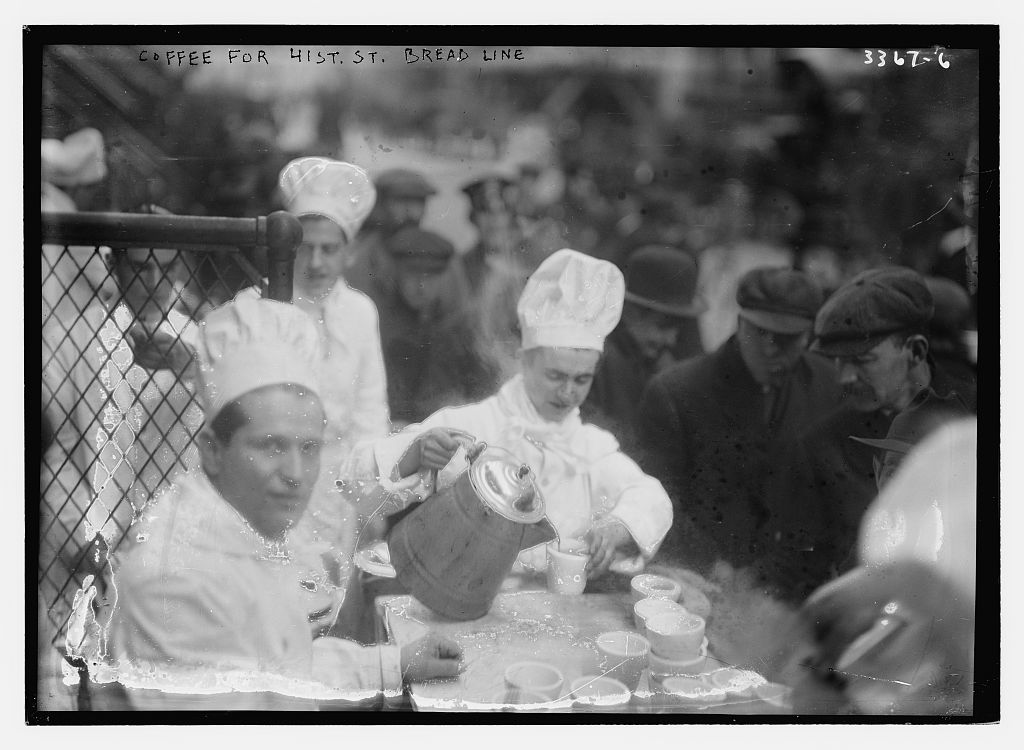
Coffee being served to a "soup" line. From the Library of Congress.
 Pre-WWI bread line. Library of CongressLOC collection via Flickr.
To get to Daily Life through History, follow this path:

1. Go to the Richland library webpage at http://www.richlandcollege.edu/library.
2. Look for the green tabs in the middle of the home page and click on “Databases."
3. Click on the “D” on the A-Z list.
4. Scroll down and click on the "Daily Life through History” link.

Pros:
  • Articles are typically short and easy to read.
  • The authors provide suggestions for further reading.
  • The citation in MLA format is posted at the end of each article.
Con:
  • This database is not useful for students who need current information. The most recent pieces on President Barack Obama, for example, are from 2011.
Here is a link to the search results for "coffee."  Students, instructors, and staff with current DCCCD I.D. can log on with their I.D. information.

~From Richland Librarian Terri C. 

Thursday, April 7, 2011

Question of the week: War by the numbers

Often our students are looking for statistics on deaths, crimes, births, voting rates, marriages, or accidents.

This week, a Richland student needed to know the number of civilian deaths in Germany and Japan during World War II. She had searched the Internet but didn't find what she wanted, so she came to the library reference desk for an old-fashioned encyclopedia.

Moving over to the D* shelves, we pulled a couple of titles including The Oxford Companion to World War II.

It turned out that this 1301-page book was just what our student needed. Chock full of maps, lists, definitions, and photos, the alphabetical volume includes a short section called "demography of the war." This section lists war-related deaths and breaks them down into military and civilian losses.

Not near our desk or book shelves? Students across campus or off campus might want to try accessing an online reference for this type of question. The Encyclopædia Britannica Online is available to current DCCCD students, faculty, and staff. 

Go to http://www.richlandcollege.edu/library. Click on the green "Databases" tab; at the next screen, click on "E"; and at the next screen, scroll down to the "Encyclopaedia Britannica" link. Click through, and log on with your school I.D.

If you search for "costs of the war," you should find an article on war-related losses.

Now back to the question: What were the costs of war?

Japan lost some 350,000 civilians during the war, and Germany lost 2,000,000; these numbers are considered unreliable, according the The Oxford Companion, so we may never know the answer.

Keep searching,
R.D.
 

Dear, Ian, and Michael Richard. The Oxford companion to World War II. New York: Oxford University Press, USA, 1995. Print.


*What are the D shelves? Great question! Richland Library uses the Library of Congress classification system to shelve books, and D is the section in which books about world history and the history of Europe are shelved.

Monday, March 8, 2010

What do you know about Texas?

Quick! What is the Texas state insect? The official large mammal? What color is the Texas state tartan? What is the origin of the name of the Lavaca River?

The answers to these and many other questions regarding "all things Texan" can be found in the latest edition of the Texas Almanac. The Texas Almanac has a long and interesting history. Now in its 65th edition, the Almanac was first published in 1857 and has been regularly issued annually or biennially with few interruptions to the present day. This new edition of the Texas Almanac is the first one to be published by the Texas State Historical Association. Editor Elizabeth Cruce Alvarez states in the Dallas Morning News, "This edition of the Texas Almanac is the most comprehensive and colorful edition yet." Every library, home or office should have a copy.

Had I known about the pronunciation guide in the Texas Almanac when I first moved to San Antonio back in the early 1960's I wouldn't have been so confused about the name of the county in which I resided. I kept reading about Bexar County and never related it to the county name I was hearing on the news. Bexar, for the new-to-Texas reader, is pronounced BA ar, not BEX ar.

You can read more about the Texas Almanac on their Web site (http://www.texasalmanac.com/) or in the Dallas Morning News. Better yet, stop by the Richland College Library reference desk and have fun browsing the beautiful new edition.

Friday, September 4, 2009

New Tool Provides Research Assistance

Research just got easier thanks to a new tool at the Richland College Library. LibGuides is a collection of searchable research guides built by librarians. These guides will direct you to authoritative print and online resources selected by librarians. For example, this general Research Guide will help you get started with most research assignments. We also have guides for specific classes and assignments, such as these guides for Fine Arts Appreciation and an English assignment on The Rebel as Hero.


Librarians aren’t the only ones who get to have fun. You can also contribute these research guides. Most guides allow you leave comments. Some even allow you to suggest or rank resources. See the RCHS Capstone research guide for examples of user-rated resources.


Instructors, if you would like a research guide for one of your classes or assignments, contact your Library Liaison.

Academic Enrichment: Gary Duke

Engineering, Business, and Technology (all disciplines): Jeanetta Burnham

Ethnic Studies, Social Science and Physical Education (all disciplines): Alice Fulbright

Human and Academic Development (all disciplines): Sharlee Jeser-Skaggs

Humanities, Fine and Performing Arts
Mathematics, Science and Health Professions (all disciplines): Amy Ferguson

Teacher Preparation (all disciplines): Sharlee Jeser-Skaggs

World Languages, Culture and Communication

The old library pathfinder has been reborn!

Wednesday, July 22, 2009

A new type of research engine: WolframAlpha


In May 2009, the new computational search engine called WolframAlpha went live. This is not your average and typical search engine. It is called a computational search engine because of what it does best: computing from its own knowledge base. It aims to return an answer to your query rather than millions of web page results. Click on the examples page to see just some of what it can do related to science, math, geography, weather, and more.


Friday, May 15, 2009

A hidden gem from our reference book collection: Business: The Ultimate Resource 2nd edition. This 2,000 page book contains just about everything you ever wanted to know about business and management and has been described by USA Today as “..the closest we have to a business bible.” It includes best practices relating to people and culture, marketing, systems, productivity, and others. Additionally there are numerous checklists and action lists one can refer to while on the job or while looking for a job. Profiles of business thinkers and management giants are also available. Find it in the reference collection at call# HD 38.15 .B878 2006.


Friday, April 3, 2009

Interesting reference questions

Here are some of the more memorable reference questions we have received at the Richland Library reference desk. Enjoy!

  1. How to write an essay on philosophy (topic: write from the viewpoint of a bat)
  2. What was the name of the Richland lake before it was named "Thunderduck?"
  3. What do you do if your vet removes the wrong organ?
  4. I need personal narratives from people who committed crimes while they were on drugs.
  5. Does html stand for Hotmail?
  6. I need a list of myths that have been proven scientifically.
  7. I added items to my cart in Amazon.com, so why is it empty?
  8. How to I vote for President online?
  9. Where can I find information about the benefits of drinking urine?
  10. How to translate a document from English to Vietnamese online for free
  11. What direction is North?
  12. What is the largest named number?
  13. Where and when can I look in the sky to view Skylab?
  14. "I need a liberal view and a conservative view." On what topic, the librarian asked. "Oh, any topic will do."
  15. Where is the Teaching, Learning, Community Building located?